

Bike rooms are no longer designed for one type of bicycle.
Today’s developments must accommodate:
- Standard commuter bikes
- E-bikes
- Fat tire bikes
- Bikes with full fenders
- Cargo bikes
- Performance mountain bikes
Designing bike infrastructure without accounting for these variations leads to inefficient layouts, damaged equipment, and frustrated users.
The solution is not a generic wall hook.
It is a coordinated vertical parking strategy anchored in commercial-grade infrastructure.
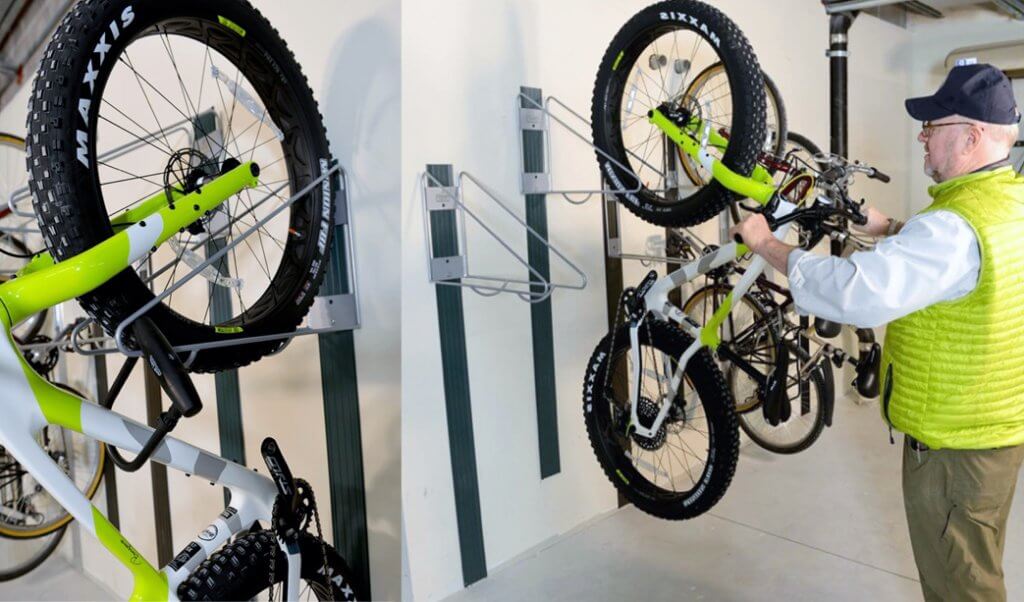
CycleSafe’s FattyRack™ Fat Tire Wall Rack (Product #17553) is purpose-built to store bikes with tires up to 5.25″ wide, while maintaining the structural and planning discipline required in professional bike rooms.
Built on the Original Commercial Wall Rack Platform
Nearly 20 years ago, CycleSafe introduced the Original WallRack™, the first vertically-hanging commercial wall rack engineered to properly cradle a bike’s front wheel between two tire supports.
Unlike hook-based systems that hang the rim, the patented WallRack™ design:
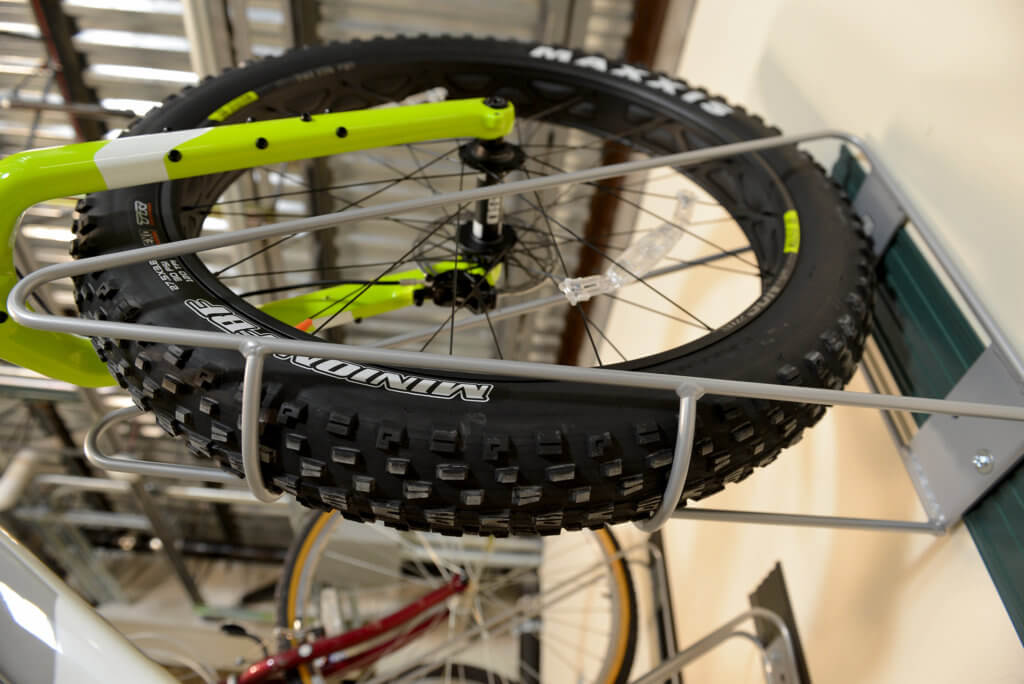
- Supports the wheel between two curved tire cradles
- Avoids rim stress
- Allows secure U-lock engagement
- Mounts structurally to cement, block, wall studs or chain-link fencing
- Frees up valuable floor space
Since its introduction, the design has been widely imitated, often by inferior products that eliminate the engineered cradle geometry and replace it with simple hooks or straight supports.
FattyRack™ extends that proven platform.
It preserves the cradle-based wheel support system but expands tire capacity to 5.25″, accommodating the growing presence of fat tire bikes in urban developments.
The Problem with Imitation Vertical Racks and Residential Hooks
Many vertical racks on the market:
- Hang bikes from a single hook
- Apply stress directly to the rim
- Ignore handlebar clearance planning
- Use light-gauge steel
- Include non-structural hardware
- Lack commercial finish durability
Retail-grade racks may function in private garages.
They fail in shared bike rooms.
Commercial installations require:
- Structural anchoring
- Proper spacing guidance
- Tamper-resistant hardware
- U-lock compatibility
- Durable powder coat finishes
- Long-term load performance
FattyRack™ is engineered specifically for those conditions.
Why Fat Bikes Require Dedicated Vertical Storage
Fat tire bikes are no longer recreational outliers.
They are increasingly common in:
- Multifamily residential developments
- University campuses
- Transit-oriented projects
- Corporate campuses
- Municipal garages
These bikes often feature:
- Tires up to 5.25″ wide
- Heavier frames
- Wider handlebars
- Integrated accessories
Attempting to fit them into standard 2.25″ wall racks creates interference and rim pressure.
FattyRack™ resolves that issue while maintaining space efficiency.
Technical Overview
- Part Number: 17553
- Capacity: 1 bike
- Tire Capacity: Up to 5.25″ wide
- Material: Heavy-duty 3/8″ steel wire frame
- Finish: Polyester powder coat
- Standard Color: Traffic Black, RAL 9017; other and custom colors available
- Mounting Holes: 12″ apart
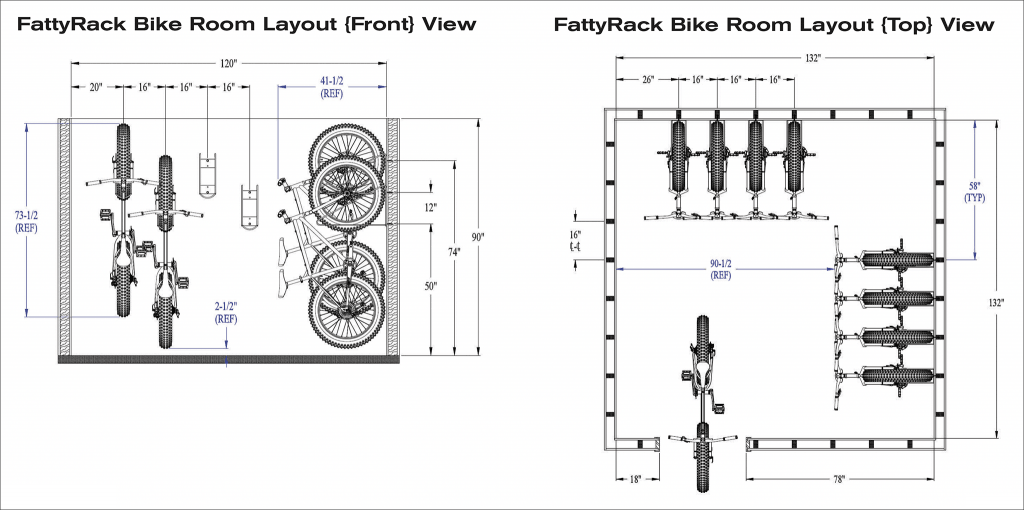
- Recommended Spacing: 16″ between racks
- Handlebar Offset: 12″
- Recommended Aisle Clearance: 4–6 feet
- Hardware Included: Tamper-resistant 5/16″ lag screws
- Mounting Surfaces:
- Wall studs (16″ O.C.)
- Concrete/block
- Chain-link fence
Chain-Link Fence Mounting: A Critical Infrastructure Detail
Many modern bike rooms are enclosed with chain-link partitions inside parking garages or retrofit areas.
FattyRack™ is designed to mount securely to:
- Structural walls
- Concrete surfaces
- Chain-link fence systems
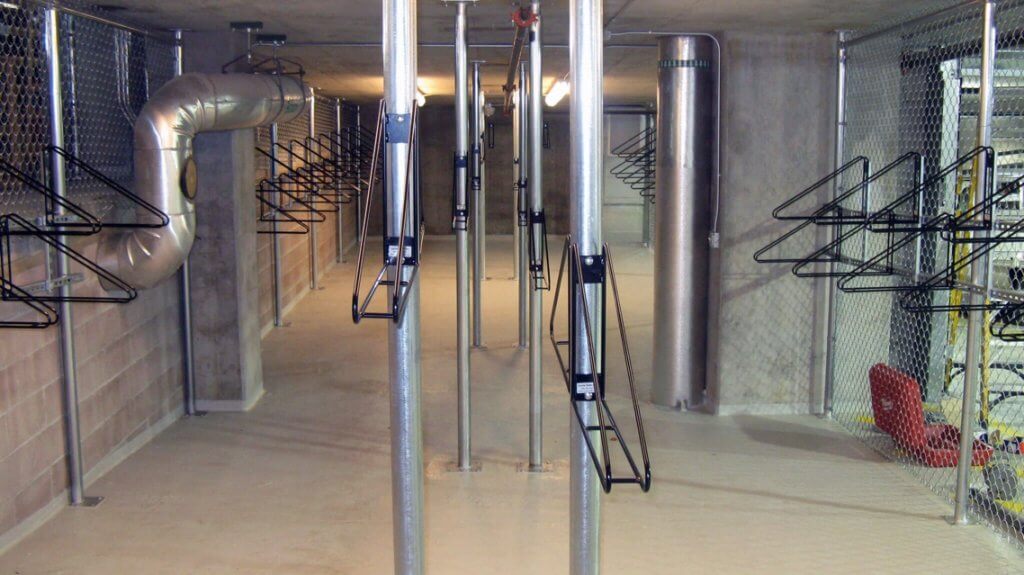
This allows planners to implement vertical parking inside:
- Secured bike cages
- Transit station enclosures
- Parking structure storage zones
- Temporary or phased bike areas
Few consumer wall racks provide this flexibility.
Diversifying Vertical Bike Parking: A Smart Planning Strategy
Bike room design should not assume one bike type.
CycleSafe recommends recommend diversifying bike room parking with 20% FattyRack and FenderRack, as standard bikes can also be parked using the FattyRack or FenderRack in most applications.
Why?
Because:
- Standard bikes can use WallRack™
- Fat bikes can use FattyRack™
- Bikes with fenders require FenderRack™
- FattyRack™ and FenderRack™ can also accommodate standard bikes
This flexible mix ensures:
- Broader user compatibility
- Future-proofed infrastructure
- Reduced conflict between users
- Improved overall room utilization
Rather than overbuilding with oversized racks everywhere, architects can strategically integrate FattyRack™ where appropriate.
Accessory Integration: WallRack Tire Guard Plate
In finished bike rooms, tire scuffing on walls becomes a maintenance issue.

The WallRack Tire Guard Plate accessory:
- Protects adjacent wall surfaces
- Preserves interior finishes
- Reduces repainting cycles
- Maintains aesthetic quality
This is particularly valuable in:
- Class A multifamily developments
- Corporate campuses
- LEED-oriented projects
- Amenity-focused residential communities
It reinforces the difference between hobby hardware and infrastructure-grade planning.
Commercial vs Residential Vertical Bike Racks
| Residential Hook | CycleSafe FattyRack™ |
| Single-point rim hook | Dual cradle tire support |
| Light-gauge steel | 3/8″ heavy-duty wire |
| No spacing guidance | 16″ spacing + 12″ offset |
| Consumer hardware | Tamper-resistant lag screws included |
| Garage storage use | Commercial shared bike rooms |
| Thin retail coating | Durable polyester powder coat |
The distinction is not cosmetic.
It is structural.
Integrating FattyRack™ into Infrastructure Configurations
FattyRack™ performs best when incorporated into a larger system, including:
- Standard WallRack™ units
- FenderRack™ units
- High-density floor systems
- ProPark® lockers
Proper planning includes:
- 16″ rack spacing
- 12″ offset
- 4–6 ft aisle clearance
- Structural mounting analysis
When combined strategically, vertical racks can dramatically increase bike room density without sacrificing usability.
The Role of FattyRack™ in Modern Bike Parking Infrastructure
Fat tire bikes are part of today’s transportation ecosystem.
Designing bike rooms without accounting for them is no longer viable.
FattyRack™:
- Extends CycleSafe’s original vertical rack platform
- Preserves patented cradle support geometry
- Accommodates tires up to 5.25″
- Mounts to walls or chain-link fencing
- Integrates into diversified parking strategies
- Meets commercial durability standards
When specifying bike infrastructure, the goal is not to hang bicycles.
The goal is to design resilient, flexible parking systems that serve evolving communities.
Request a quote or talk with a CycleSafe bike room specialist to incorporate FattyRack™ into your next bike parking configuration.
