

As cycling demand continues to grow across multi-family developments, transit hubs, corporate campuses, and higher education facilities, one challenge consistently rises to the top:
How do you provide more bike parking in less space—without sacrificing usability or increasing maintenance?
CycleSafe’s answer is the OctoRack™ Hi-Density Bike Rack, an innovative high-density bike rack designed specifically for covered bike parking, bike rooms, and parking garages where space efficiency and long-term durability matter most.
The OctoRack™ formally expands CycleSafe’s high-density portfolio and provides architects, specifiers, developers, and property managers with a practical alternative to tray-style lift-assist systems.
Why High-Density Bike Parking Is Now a Design Requirement
Across North America, bike parking codes increasingly require:
- Class-I secure indoor parking
- Higher bike-to-unit ratios in multi-family projects
- Covered bike parking at transit facilities
- Large-capacity bike rooms in corporate and university settings
These requirements often push projects beyond traditional single-level racks and into double-tier bike rack systems.
But not all two-tier bike parking systems are created equal.
Many tray-style systems:
- Require 102” or more vertical clearance
- Introduce moving parts that require maintenance
- Create liability concerns when trays fail or bind
- Require wider aisles
- Demand full-bike lifting effort
The OctoRack™ was engineered specifically to solve these challenges.
What Makes the OctoRack™ Different?
Reduced Lifting Force—50% Less Effort
Traditional lift-assist tray systems require users to lift the full weight of the bike plus the tray.
The OctoRack™ takes a different approach.
Instead of lifting a heavy sliding tray, the cyclist:
- Places only the front wheel into the upper guide channel
- Lifts the rear wheel
- Rolls the bike forward into a fixed guide channel notch
This design reduces lifting force by approximately 50% compared to traditional tray systems, improving usability for:
- Commuters with e-bikes
- Students
- Transit riders
- Daily-use riders
Ease-of-use directly impacts adoption rates. If upper-tier racks are difficult, they go unused. The OctoRack™ keeps both tiers practical and usable.
96-Inch Clearance Requirement (vs. 102” Competitors)
Many high-density double-tier systems require 102” to 108” ceiling clearance.
The OctoRack™ operates with a 96-inch minimum clearance height, allowing it to fit in:
- Existing parking garages
- Retrofit bike rooms
- Sheltered areas under existing structures
- Lower slab-to-slab developments

This 6-inch difference can be the deciding factor in retrofit feasibility, particularly in urban infill and adaptive reuse projects.
For architects working within constrained vertical space, this is a major specification advantage.
High-Density Bike Racks Submittal Sheet
No Movable Tray = Lower Maintenance & Liability
One of the most common long-term issues with lift-assist tray racks is:
- Worn springs
- Binding rollers
- Bent tray rails
- Misaligned glide systems
The OctoRack™ eliminates movable trays entirely.

Instead, it uses:
- Fixed steel wheel guide channels
- A fixed lock bar
- Multiple U-lock attachment points
By eliminating moving mechanical components, the OctoRack™:
- Reduces maintenance costs
- Eliminates failure-prone parts
- Reduces long-term liability
- Improves lifecycle durability
For property managers and facility operators, fewer moving parts means fewer service calls.
Designed for Covered Bike Parking & Indoor Bike Rooms
The OctoRack™ is purpose-built for:
- Indoor bike rooms
- Parking garage bike racks
- Covered bike parking shelters
- Secured access bike storage areas
Its steel construction includes:
- Zinc primer
- TGIC polyester powder coat finish
This provides corrosion resistance and long-term durability in semi-exposed environments.
The guide channel accommodates tire thicknesses from 30mm–60mm, covering most commuter and standard e-bike tire profiles. The steel guide channel also provides multiple locking holes for standard U-locks or cable for a variety of bike sizes.

Capacity & Configurability
Each OctoRack™ unit stores eight bikes in a compact footprint.
Staggered wheel channel heights eliminate handlebar entanglements and allow bike spacing at 18” on center.

Large-capacity systems can be created by:
- Placing units back-to-back for dual-sided access
- Installing side-by-side rows; (recommended aisle clearance is only 72”)
This modular approach makes the OctoRack™ ideal for projects requiring 20+ racks and larger total bike counts.
For high-capacity planning guidance, refer to CycleSafe’s Bike Room Planning resources:
- Features of a Successful Indoor Bike Room Design
- Bike Room Layout
- High-Density Bike Room Parking: Secure, Space-Saving Solutions for a Smarter, More Inclusive Future
- High-Density Bike Room Solutions
Quad Hi-Density Rack vs. OctoRack™ — When to Specify Each
CycleSafe offers two high-density rack systems. Understanding when to use each is key.
Quad Hi-Density Rack
- Four-bike capacity per unit
- Double-tier system
- Pivoting lock bar
- UV resin wheel gutters
- 96” minimum clearance
- Excellent for smaller bike rooms or phased installations
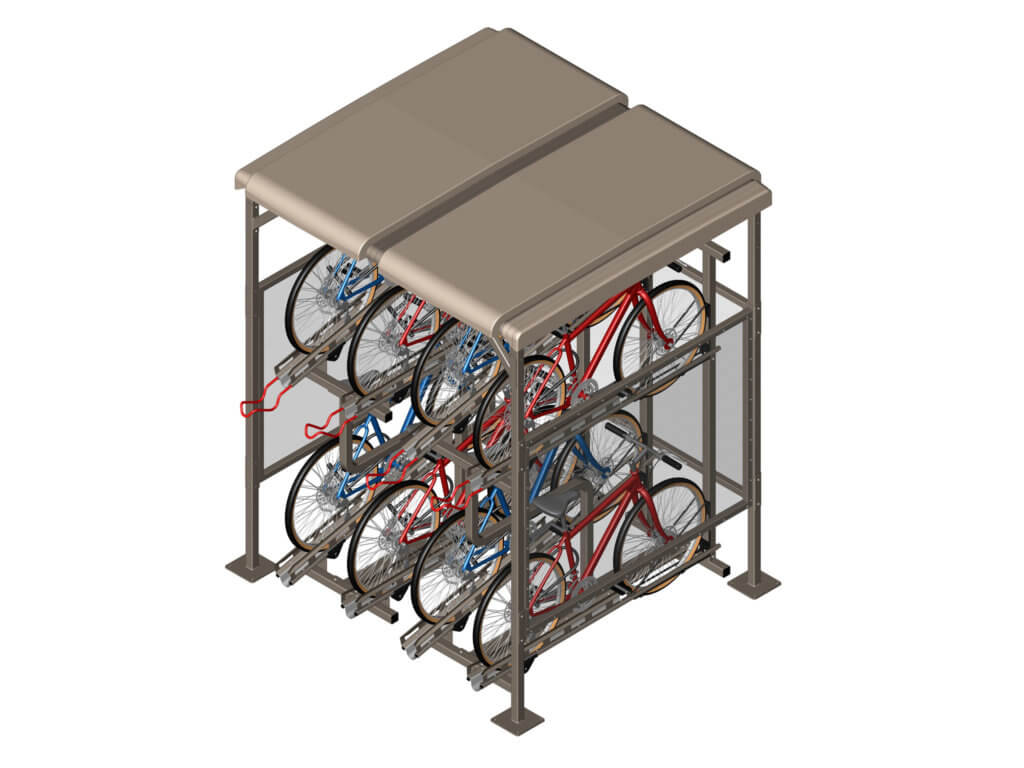
Best for:
- Integration with CycleSafe Bike Shelters and Bike Stations
- Moderate-density bike rooms
- Smaller apartment buildings
- Projects under 16-bike capacity
OctoRack™
- Eight-bike capacity per unit
- Fixed guide channels
- No movable tray
- Reduced lifting force
- 96” minimum clearance
- Ideal for large-capacity systems

Best for:
- Multi-family developments
- Transit hubs
- Corporate campuses
- Higher education facilities
- 20+ rack installations
- Retrofit garage applications
Specification guidance:
If the project requires large-scale, modular, high-capacity systems with minimal maintenance exposure, the OctoRack™ is typically the preferred solution.
For full technical details, including dimensions, submittals, configuration, and installation, see the OctoRack™ product page.
Ideal Applications for the OctoRack™
Multi-Family Developments
Developers are under increasing pressure to meet bike parking ratios without sacrificing rentable square footage.
The OctoRack™:
- Maximizes bikes per square foot
- Fits within 96” slab conditions
- Reduces maintenance costs for property operators
Transit Agencies
Transit stations require:
- Covered bike parking
- High turnover
- Durable public-facing infrastructure
The OctoRack™ eliminates tray failure issues common in high-traffic environments.
Corporate Campuses
Employers promoting sustainable commuting need scalable systems that look organized and professional.
Back-to-back OctoRack™ installations create clean, high-capacity rows that integrate well into structured parking garages.
Higher Education
Universities face extreme bike density in limited space.
The OctoRack™:
- Improves ease-of-use
- Reduces vandalism exposure
- Maximizes indoor bike room density
Technical Highlights
- Eight-bike double-tier capacity
- 96-inch minimum clearance
- Zinc primer + TGIC powder coat
- Steel wheel channels
- 30mm–60mm tire compatibility
- Fixed lock bar with multiple U-lock points
- Modular expandable configurations
For dimensions and CAD downloads, visit the OctoRack™ product page.
Frequently Asked Questions (FAQ)
A high-density bike rack is a system designed to maximize the number of bicycles parked per square foot, often using double-tier or two-tier configurations.
Most systems require 102” or more. The OctoRack™ operates with a 96” minimum clearance.
Traditional tray systems can be. The OctoRack™ reduces lifting force by approximately 50% by eliminating the need to lift a heavy sliding tray.
Yes. The OctoRack™ is specifically designed for indoor bike rooms and parking garage installations.
Systems with moving trays require maintenance. The OctoRack™ eliminates movable trays to reduce service needs.
The Smarter Alternative to Tray-Style Systems
When specifying a double-tier bike rack, usability, durability, and clearance constraints matter.
The OctoRack™ delivers:
- Less lifting effort
- Lower clearance requirement
- No tray maintenance
- Higher modular capacity
- Long-term durability
For architects and developers designing modern, high-density bike parking environments, the OctoRack™ provides a more practical path forward.
Speak with a CycleSafe representative to evaluate whether the OctoRack™ is right for your next project.
