
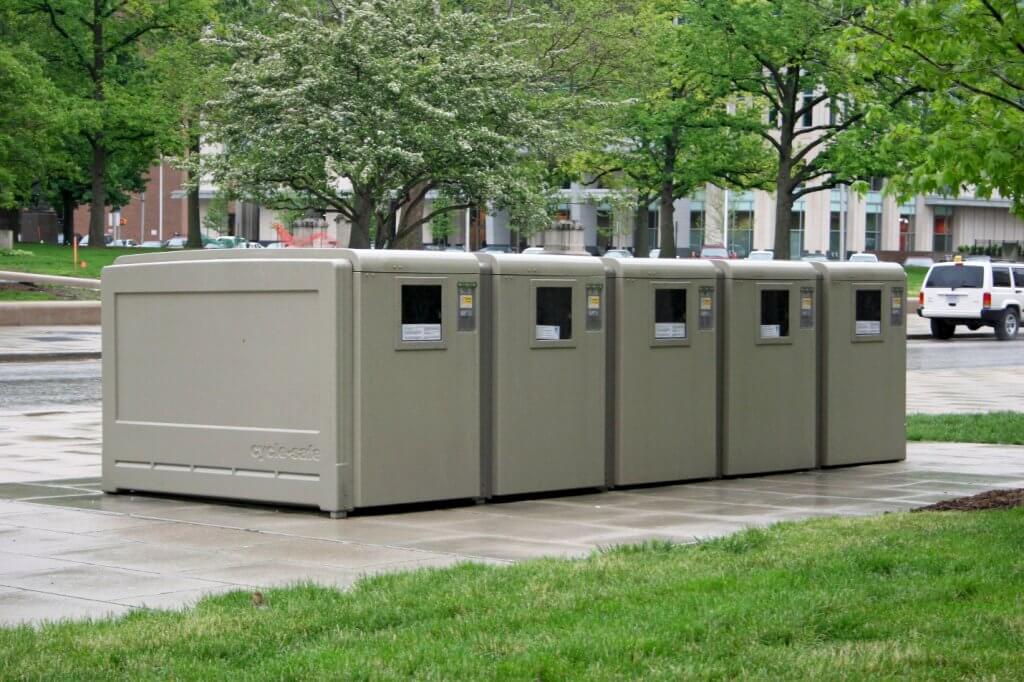
Bike parking infrastructure is often evaluated based on upfront cost. But for property owners, municipalities, universities, and developers, the true cost of bike lockers is determined over decades—not years.
Modular bike locker systems fundamentally change how bike parking performs over its lifecycle, offering advantages in durability, scalability, maintenance, and long-term cost.
The Problem with Traditional Metal Bike Lockers
Metal bike lockers have historically been selected based on lower upfront cost. However, this initial savings often obscures long-term performance issues that emerge over time—particularly in exposed or high-use environments.
- Corrosion and environmental degradation
- Structural deformation from impacts
- Increasing maintenance requirements
- Full-unit replacement when damaged
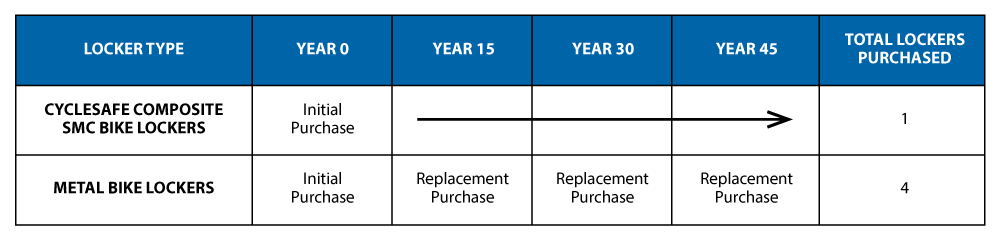
These issues compound over time, often leading to premature failure. In many cases, metal lockers require replacement within 10–15 years, creating a second capital expense cycle that is rarely accounted for during initial planning. For owners and developers, this shifts bike parking from a one-time investment into a recurring cost.
Long-Term Performance with SMC Construction
CycleSafe lockers use compression molded Sheet Molding Compound (SMC), a material engineered specifically for long-term durability in demanding outdoor and high-use environments.
- Impact resistance
- UV stability
- Corrosion resistance
- Graffiti resistance
Unlike metal systems that degrade over time, SMC maintains both structural integrity and appearance over decades of use. With a proven, real-world lifespan of 45+ years, this material fundamentally changes the lifecycle cost equation—shifting bike parking from a replaceable asset to long-term infrastructure.
Modular Design: What It Means and Why It Matters
Modular construction is not just a manufacturing detail—it is a system-level advantage that directly impacts how bike parking performs over time. Each locker is built from integrated, replaceable components that function as part of a larger system, allowing installations to evolve alongside changing needs.
Scalability
- Add lockers to existing banks as demand grows
- Expand installations without replacing original units
Reconfiguration
- Relocate lockers within a property
- Rebalance capacity across multiple sites
Adaptability
- Adjust to changing usage patterns
- Support evolving site requirements
Together, these capabilities allow bike parking infrastructure to respond to real-world usage rather than remaining fixed from the time of installation.
See how starter units, adder units, and interlocking design enable scalable, space-efficient bike parking systems.
Repair vs Replacement: A Critical Cost Advantage
The difference between modular and non-modular systems becomes especially clear when damage occurs—a common reality in active environments such as campuses, transit sites, and commercial properties.
Traditional Systems:
- Structural damage often compromises the entire unit
- Full locker replacement is required
Modular SMC Composite Systems:
- Damaged panels or components can be replaced individually
- Core structure remains intact
Because repairs can be isolated to specific components rather than entire units, modular systems deliver meaningful operational and financial advantages:
- Lower repair costs
- Reduced downtime
- Extended useful life
For facilities teams and asset owners, this shifts maintenance from disruptive replacement cycles to manageable, incremental repairs.
Understand how material choice affects durability, maintenance, and long-term cost performance.
Maintenance Advantages
Beyond durability, modular SMC lockers significantly reduce ongoing maintenance requirements—an important consideration for facilities teams managing multiple assets across a property or portfolio. Key maintenance advantages include:
- No repainting required
- No corrosion mitigation
- Minimal cleaning requirements
- Durable finishes that resist wear
These characteristics reduce both the frequency and complexity of maintenance tasks. For facilities teams, this translates into lower maintenance budgets, reduced labor requirements, and greater reliability over time—particularly in environments where access, downtime, or staffing may be constrained.
Capital Efficiency and Phased Investment
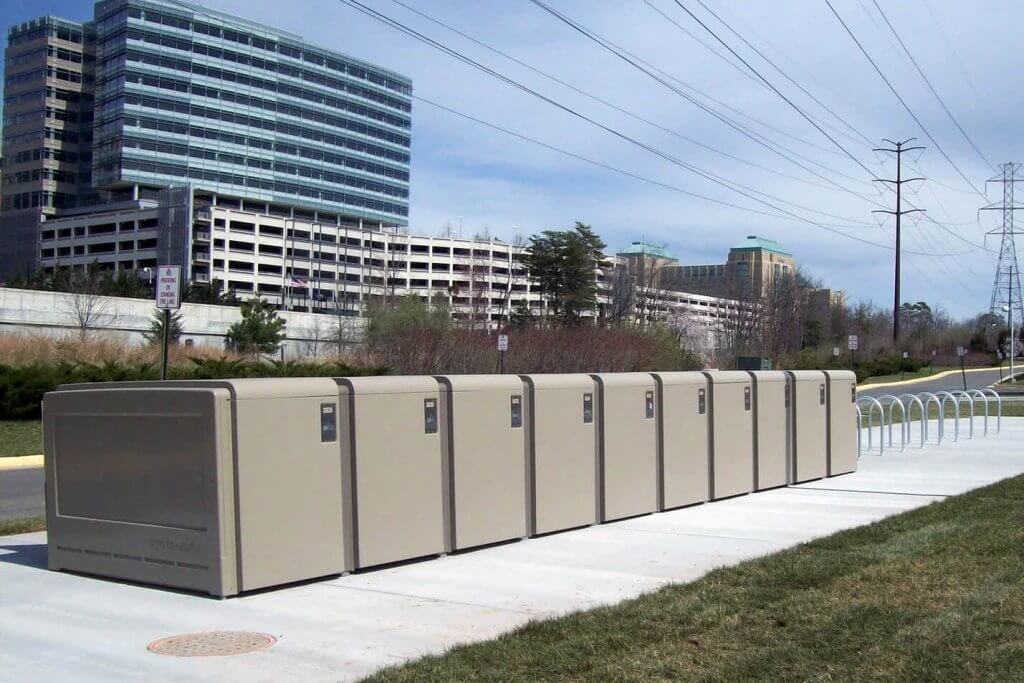
Modular systems allow property owners and developers to align infrastructure investment with actual demand, rather than committing to fully built-out solutions upfront.
Instead of overbuilding:
- Start with a right-sized installation
- Expand as usage grows
This phased approach improves capital efficiency while reducing risk. It also supports more flexible project planning, particularly in developments where bike usage may evolve over time.
As a result, modular systems contribute to:
- More effective capital allocation
- Improved project feasibility
- Stronger long-term return on investment
Applicable Across Markets
These advantages apply across a wide range of applications:
- Hospitality properties
- Universities and campuses
- Transit systems and mobility hubs
- Commercial and mixed-use developments
- Municipal and public infrastructure
In each case, modular systems support long-term planning and operational flexibility.
Infrastructure That Performs Over Decades
Bike parking should be treated as long-term infrastructure—not a short-term purchase.
Modular bike lockers provide:
- Durability measured in decades
- Flexibility to adapt over time
- Cost savings through reduced replacement and maintenance
For stakeholders responsible for capital planning, operations, and long-term performance, modular systems represent a fundamentally better approach to bike parking infrastructure.
Work with CycleSafe to evaluate modular bike locker solutions that align with your site, budget, and long-term performance goals.
