
For a growing segment of travelers, the presence—or absence—of secure bike storage can determine whether a hotel is even considered. As cycling tourism expands and more guests travel with high-value bikes and e-bikes, expectations around bicycle parking are shifting rapidly. What was once treated as a minor amenity is increasingly viewed as essential infrastructure—particularly for properties seeking to attract cycling-oriented guests.
For hotel developers and operators, this shift presents a clear strategic implication: properties that rely solely on exterior bike racks may be underbuilt for today’s cycling traveler, while those that invest in secure, well-designed storage can differentiate themselves in competitive markets.
For architects, specifiers, and Division 10 consultants, this shift also has direct implications for project planning. Bike parking is no longer a secondary site element—it is increasingly a specified component of building programs, requiring coordination with site design, security systems, and long-term operational considerations.
The Rise of Cycling Tourism and Higher Expectations
Cycling participation continues to grow across North America. According to PeopleForBikes, more than 112 million Americans rode a bicycle at least once in 2024, reflecting record participation levels and a broadening user base.
At the same time, cycling tourism has become an increasingly important segment of regional and destination-based travel economies.
This shift is also being driven by the increasing value of the bicycles themselves. High-performance road bikes, gravel bikes, and especially e-bikes often represent investments of $3,000 to $10,000 or more. As a result, cyclists are far less willing to leave bikes unsecured or exposed to weather conditions. The higher the value of the equipment, the higher the expectation for secure, enclosed, and reliable storage—particularly for overnight stays.
These factors are reshaping expectations. Cyclists are no longer simply looking for a place to lock a bike—they are looking for infrastructure that protects their equipment and supports their travel experience.
Secure Bike Storage as a Baseline Requirement
Research supports the idea that secure bike parking and storage is not just a preference but an expectation for a meaningful segment of travelers. A Visit Wales study found that 45% of cyclists consider secure, covered bike storage an essential requirement when choosing accommodations.
Similarly, cycling tourism operators often treat secure bike storage as a minimum standard. In a 2025 Welsh Government study, tour operators described bike storage as a “main absolute must” when selecting accommodation partners.
Certification programs reinforce this expectation. Organizations such as Ontario By Bike and Cycling UKrequire secure, covered bike storage as part of their accommodation criteria.
In markets where cycling tourism is well established, the absence of secure bike parking and storage may not simply reduce a property’s appeal—it may remove it from consideration entirely.
See how secure bike storage is applied to support guest needs and hospitality operations.
Why Exterior Bike Racks Often Fall Short
Despite these expectations, many hotels continue to rely on exterior bike racks. While racks may be sufficient for short-term parking, they often fall short in hospitality environments.
Exterior racks typically leave bikes exposed to theft, weather, and overnight risk. They offer limited protection for high-value or electric bikes and do little to provide peace of mind for guests traveling with expensive equipment.
In contrast, secure bike storage solutions—such as lockers or controlled-access bike rooms—are designed to address these risks directly.
For hospitality teams evaluating how to move beyond basic bike racks, the key question is not whether to provide bike parking—but what level of security and usability today’s travelers expect. Understanding the differences between Class I storage solutions is critical to making the right long-term investment.
Class I Bike Parking: Bike Rooms vs Bike Lockers
For hotels seeking to provide secure, long-term (Class I) bike parking, two primary approaches are commonly used: indoor bike rooms and outdoor bike lockers. Class I bike parking refers to fully secure, long-term storage intended for employees, residents, or overnight users. These solutions prioritize protection from theft and weather and are typically required in many municipal codes and development guidelines.
Indoor Bike Rooms
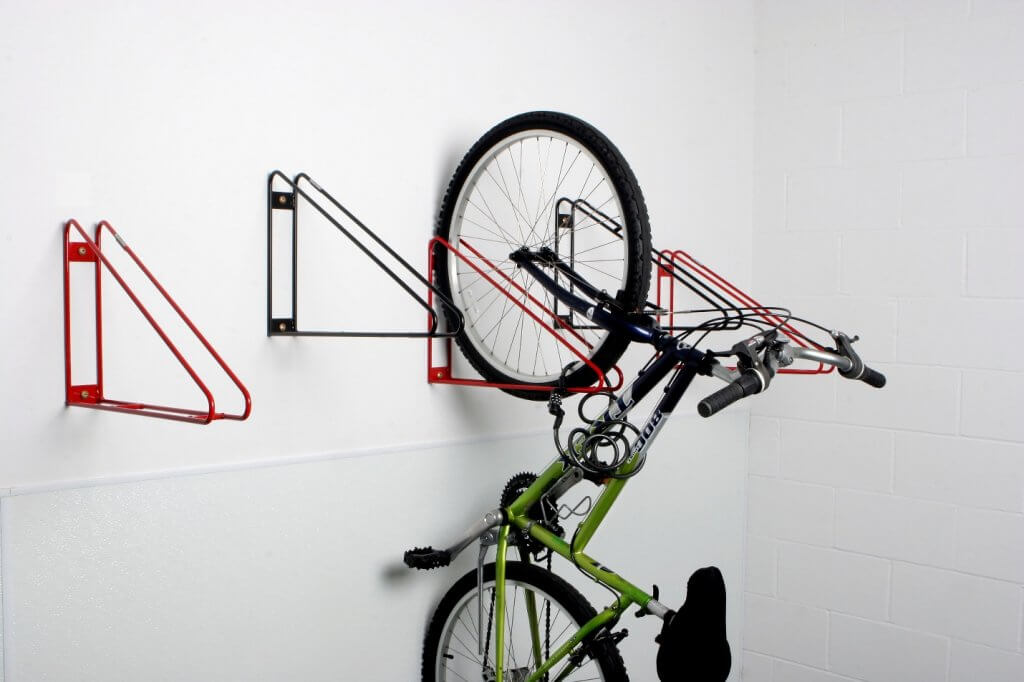
Indoor bike rooms utilize dedicated interior space and offer a high degree of flexibility and capacity for secure bicycle storage. These spaces can be configured with a range of storage solutions, including vertical and horizontal wall racks, double-tier high-density systems, and secure individual lockers within the room. This flexibility allows designers to tailor layouts to available space, user demand, and the types of bicycles being accommodated.
Well-designed bike rooms can support a wide range of bicycle types, including eBikes, cargo bikes, and fat tire bikes. Incorporating a mix of rack types, appropriate clearances, and accessible layouts is often necessary to ensure usability for diverse users—particularly in hospitality environments where guest needs can vary significantly.
In addition to storage, indoor bike rooms can function as meaningful guest amenities when thoughtfully designed. Features such as repair stations, air pumps, outlets for eBikes, and secure personal storage can enhance the overall guest experience and support longer stays among cycling travelers.
However, indoor bike rooms often require:
- Construction or retrofit costs
- Access control systems
- Lighting, ventilation, and security infrastructure
- Ongoing maintenance and oversight
In practice, these requirements can introduce significant design and cost considerations, particularly in retrofit scenarios or space-constrained developments. Allocating interior square footage, coordinating building systems, and meeting code requirements can make bike rooms more complex to implement than initially anticipated.
Indoor bike rooms are often most effective in properties with sufficient available space, a stable or repeat user base, or where enhanced amenities are a priority. They can be particularly well suited to resorts, extended-stay properties, or developments where cycling is a central part of the guest experience.
However, in space-constrained or highly transient hospitality environments, indoor bike rooms may present operational and security challenges that require careful planning to address—particularly when compared to more modular, individually secured storage solutions.
Outdoor Bike Lockers
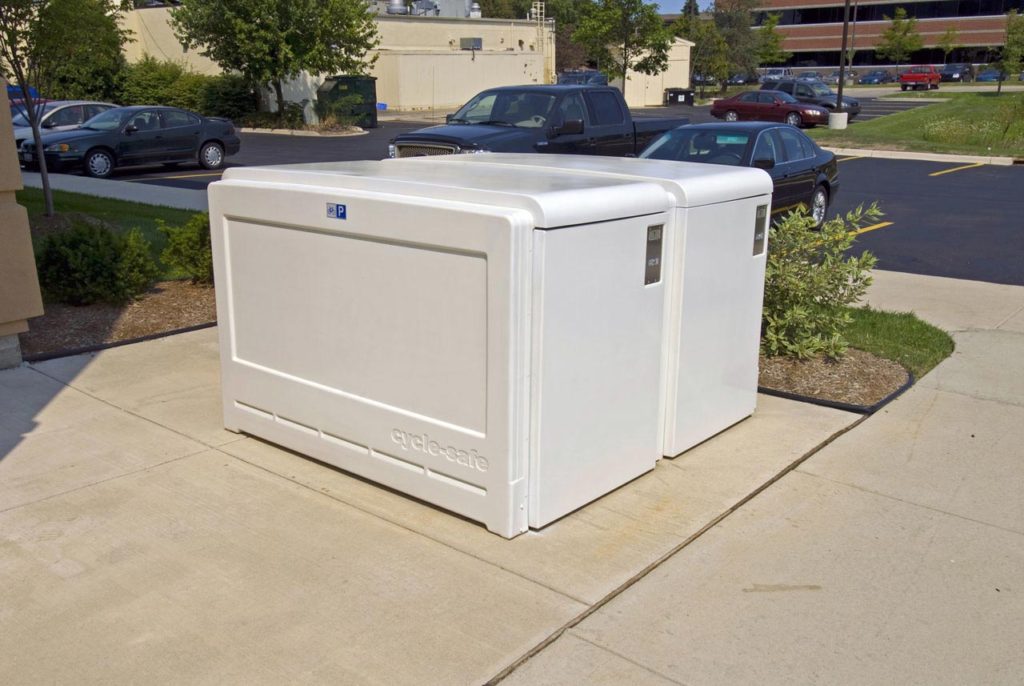
Outdoor bike lockers like CycleSafe’s ProPark® System bike lockers, provide modular, enclosed storage with:
- Higher individual security
- Scalable deployment
- Lower operational complexity
- Minimal reliance on shared access systems
In this context, modular design means that individual locker units and shared structural components are engineered to function as part of a larger, connected system. This allows installations to be configured, expanded, or reconfigured over time without replacing entire locker banks.
The CycleSafe ProPark® modular approach also allows property owners to scale installations over time as demand evolves. Additional lockers can be added to existing locker banks, or units can be reallocated—removed from underutilized areas and installed in higher-demand locations elsewhere on the property. This flexibility supports phased implementation and helps ensure that infrastructure investments align with actual usage patterns.
Because lockers are self-contained systems, they can often be deployed with fewer dependencies on building infrastructure. This makes them particularly attractive for projects where interior space is limited, where phased expansion is anticipated, or where minimizing coordination with multiple trades is a priority.
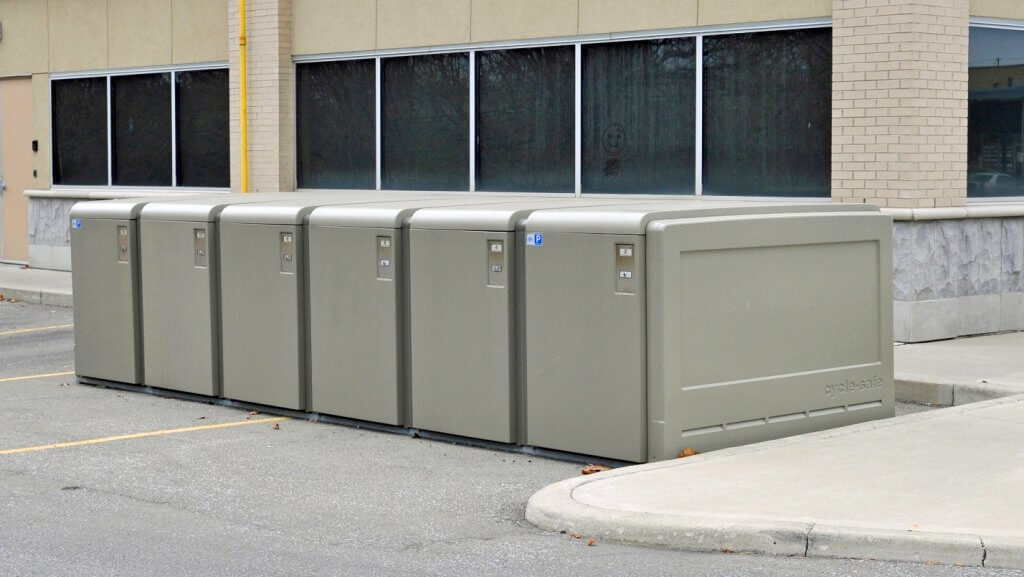
Modular construction also provides long-term maintenance advantages. If a bike locker is damaged—for example, by vehicle impact—individual panels or components can often be replaced without removing or replacing the entire unit. This can significantly reduce repair costs, minimize downtime, and extend the useful life of the installation compared to non-modular systems. In addition, because modular locker systems are designed with shared structural elements that increase overall rigidity and strength when installed in banks, this integrated design can enhance durability and resistance to tampering compared to standalone units.
These lifecycle advantages are particularly important for property owners managing long-term assets, where maintenance costs, uptime, and durability directly impact total cost of ownership. Understanding how different locker systems perform over time is a key part of making informed design and investment decisions.
Lifecycle Cost Considerations: Beyond Upfront Investment
While design decisions often begin with layout, space, and user experience, long-term performance and cost should also be considered—particularly for hospitality properties managing assets over decades.
Traditional metal bike lockers are often selected based on lower upfront cost. However, over time, exposure to weather, corrosion, and repeated use can lead to structural degradation, increasing maintenance requirements, and, in many cases, full-unit replacement within 10–15 years. This creates a recurring capital expense cycle that may not be fully accounted for during initial planning.
The long-term cost implications of these differences become more apparent when viewed across a multi-decade horizon:
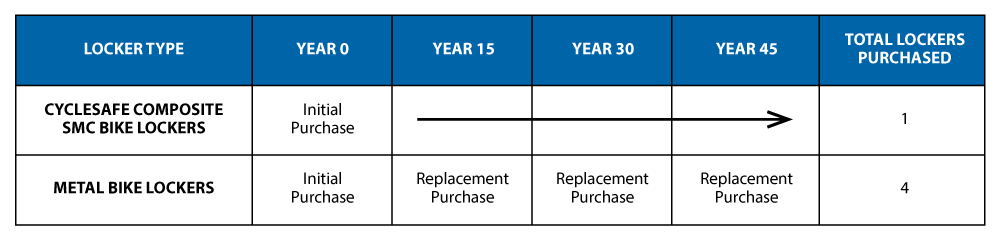
By contrast, modular bike locker systems constructed from compression-molded composite materials are designed for long-term durability and repairability. With a typical lifespan exceeding 45 years, and the ability to replace individual components rather than entire units when damage occurs, these systems shift bike parking from a replaceable asset to long-term infrastructure. For hotel operators and property owners, this can result in lower lifecycle costs, reduced operational disruption, and more predictable long-term performance.
Comparison of Bike Rooms vs Bike Lockers
By contrast, modular bike locker systems constructed from compression-molded composite materials are designed for long-term durability and repairability. With a typical lifespan exceeding 45 years, and the ability to replace individual components rather than entire units when damage occurs, these systems shift bike parking from a replaceable asset to long-term infrastructure. For hotel operators and property owners, this can result in lower lifecycle costs, reduced operational disruption, and more predictable long-term performance.
Comparison of Bike Rooms vs Bike Lockers
| Factor | Indoor Bike Rooms | ProPark® Outdoor Bike Lockers |
| Security | Shared / access-controlled | Individual enclosed |
| Cost Structure | Higher construction costs | Equipment-based, modular |
| Scalability | Limited by space | Easily expandable |
| Operations | Ongoing management required | Minimal maintenance |
| User Experience | Shared environment | Private, predictable |
| Lifecycle / Maintenance | Higher repair complexity; lifecycle: 10-15 years | Modular repair, component replacement; lifecycle: 45+ years |
| Flexibility Over Time | Fixed once built | Can expand, relocate, or reconfigure |
Understand cost, space, and operational tradeoffs before making design decisions.
When to Choose Each Approach
Selecting the appropriate bike parking solution in hospitality environments requires balancing space constraints, user expectations, operational considerations, and long-term planning goals. Both indoor bike rooms and outdoor bike lockers offer distinct advantages, and the most effective solution often depends on how a property is intended to function.
Indoor bike rooms are often well suited to properties with sufficient available interior space and a stable or repeat user base. They can support higher-capacity storage and a wider range of amenities, making them particularly effective in resorts, extended-stay properties, or developments where cycling is a central part of the guest experience. When thoughtfully designed, bike rooms can enhance user experience through integrated storage systems, repair amenities, and support for a variety of bicycle types.
However, indoor bike rooms may require more complex planning and ongoing management. Access control, visibility, user behavior, and maintenance all play a role in ensuring that these spaces remain secure and functional—particularly in hospitality environments with transient guests.
Outdoor bike lockers, by contrast, provide individual, enclosed storage that is often more predictable from both a security and operational standpoint. Their modular design allows for phased deployment, scalability, and the ability to adapt installations over time as demand changes. Because lockers are typically self-contained and require less integration with building systems, they can be especially advantageous in space-constrained sites or projects seeking to minimize coordination across trades.
In hospitality environments—particularly those with high guest turnover, limited interior space, or elevated liability concerns—individual bike lockers often provide a more consistent and secure user experience.
In many cases, a hybrid approach offers the most effective solution—combining the efficiency and amenity value of indoor bike rooms with the security, flexibility, and scalability of modular locker systems. This approach allows properties to accommodate a wider range of users while aligning infrastructure investments with both current needs and future demand.
Discuss how lockers, bike rooms, and racks can be combined for your specific site and guest profile.
Planning for eBike Storage and Charging
The rapid growth of eBike use is reshaping expectations for bike parking in hospitality environments. Compared to traditional bicycles, eBikes introduce additional considerations related to weight, value, and—most importantly—charging requirements.
For hotels and hospitality properties, this means that bike parking infrastructure must support not only secure storage, but also reliable and convenient access to power.
Integrated Charging Within Secure Storage
One approach is to incorporate charging directly within secure storage environments. Bike lockers configured with in-locker electrical access allow guests to safely store and charge their bicycles simultaneously.
This approach offers several advantages:
- Maintains high levels of security for high-value eBikes
- Eliminates the need for users to remove batteries for charging
- Reduces clutter and unmanaged charging in guest rooms
For hospitality operators, integrating charging within lockers also helps centralize infrastructure and minimize operational oversight.
Dedicated eBike Charging Stations
In addition to locker-based charging, dedicated eBike charging stations and Power Posts provide flexible, user-accessible charging infrastructure in shared environments. These stations can be deployed in both indoor and outdoor settings and are often designed with:
- GFCI-protected outlets
- Secure or semi-secure docking configurations
- Compatibility with a wide range of personal charging systems
Charging stations are particularly effective in:
- Bike rooms
- Covered parking areas
- Mobility hubs or shared-use spaces within a property
Planning Considerations for Hospitality Projects
When planning for eBike accommodation, hospitality teams should consider:
- Anticipated growth in eBike usage among guests
- The balance between secure charging (lockers) and shared charging (stations)
- Electrical infrastructure requirements and future scalability
- Integration with broader bike parking layouts and circulation
By incorporating both secure storage and accessible charging solutions, hotels can better support the evolving needs of modern cyclists—while enhancing guest experience and ensuring that infrastructure remains relevant over time.
See how integrated charging and credentialed access support modern hospitality environments.
Specifier Guidance: Choosing the Right Bike Parking Strategy
For architects, specifiers, and property developers, selecting the right bike parking solution often depends on balancing space constraints, user needs, and operational considerations.
Indoor bike rooms are well suited for:
- Properties with available interior space
- Longer-term users or repeat guests
- Amenity-rich environments where cycling is a core offering
Outdoor bike lockers are often preferred for:
- Space-constrained sites
- High-turnover hospitality environments
- Projects requiring scalable, phased deployment
- Situations where individual security and reduced operational oversight are priorities
In many cases, a hybrid approach—combining indoor bike rooms with modular locker systems—provides the most flexible and future-ready solution.
For a deeper comparison of these approaches—including cost considerations, design implications, and long-term operational tradeoffs—see the related resources at the end of this article.
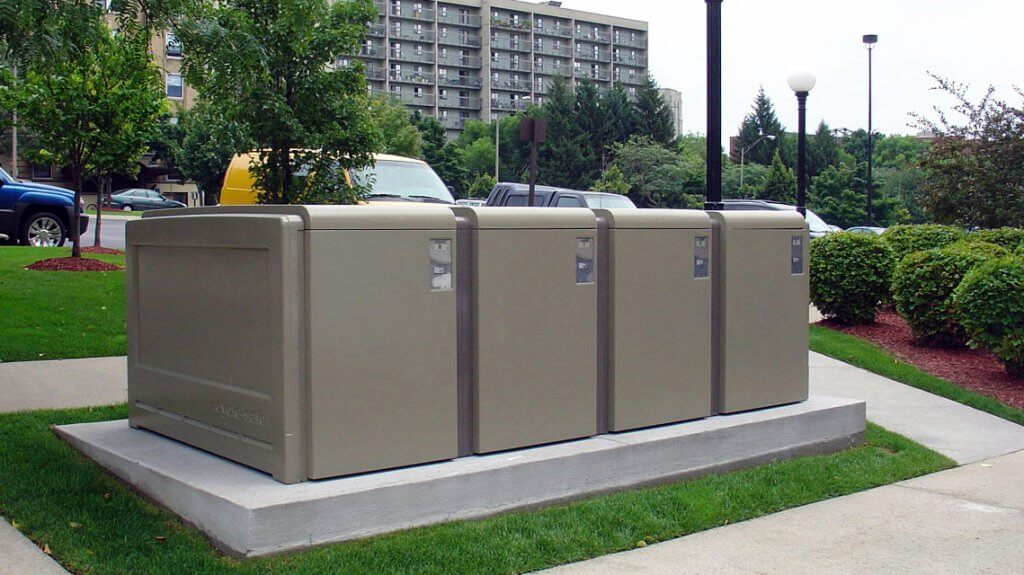
Pictured is a bank of four two-door lockers providing secure parking for 8 bikes.
Specifications That Survive Procurement
A specification can be exactly right on the page and still not survive construction.
Bike parking is particularly exposed to this. It often enters a project through a compliance pathway or a furnishings package—the same category as benches, trash receptacles, and site signage—which makes it an easy target when a general contractor or owner’s rep is looking for line items to value-engineer. A bike room sized correctly, located sensibly, and coordinated with eBike charging and guest circulation can get flagged in the same review as a light fixture swap. Six weeks later it’s a generic exterior rack near a loading dock, and nobody quite remembers deciding that.
That risk isn’t unique to architects specifying interior systems. Landscape architects and site planners face the same dynamic from the other direction: a bike parking plan that was genuinely coordinated with pedestrian flow, entrances, and trail access can get reduced, during bid review, to whichever rack is cheapest to install wherever it’s easiest—undoing the circulation logic the plan was built around.
The specifications that hold up tend to share one trait: the reasoning is written into the documentation itself, not left to be remembered in a meeting. Why a locker bank, a bike room, or a hybrid system—not just which one. How the system is sized for a duration hierarchy, not a single number. How it accommodates eBike charging or credentialed access. Modular, interlocking systems reinforce this further—because components are engineered to function as part of a coordinated system rather than a list of interchangeable parts, they’re harder to quietly substitute down to a mismatched approved-equal during bid review. The specification itself carries the coordination logic.
For architects, specifiers, and landscape architects, documenting that rationale early—before a project reaches procurement—is what determines whether what gets installed still looks like what was designed.
See how modular specifications hold up through procurement, multi-year capital plans, and changing demand.
The Business Case for Hotels
Secure bike storage is not just an amenity—it is a strategic investment. Hotels that provide secure bike parking are better positioned to:
- Attract cycling travelers
- Participate in tourism networks
- Differentiate from competitors
- Support sustainability goals
For properties evaluating how to meet this demand, the business case is not only about attracting guests, but also about making infrastructure investments that can adapt over time. Modular locker systems can support that goal by allowing capacity to expand, contract, or be reallocated as usage changes—helping properties avoid overbuilding upfront while improving long-term capital efficiency.
Properties that fail to provide secure storage risk being overlooked entirely. In competitive markets, this gap is becoming more visible. As cycling tourism grows, properties that lack secure bike storage may not simply underperform—they may be excluded from consideration by travelers, tour operators, and cycling-focused booking platforms altogether.
Understand lifecycle cost, durability, and scalability considerations for hospitality projects.
Planning Considerations for Hospitality Properties
Key considerations include:
- Location: accessible but secure
- Capacity: plan for growth
- Integration: part of site design, not an afterthought
Well-planned bike infrastructure enhances both operations and guest experience. Additional considerations may include user access control, lighting and visibility, integration with site circulation patterns, and coordination with local bike parking requirements. Early alignment between design teams and ownership can help ensure that selected solutions meet both user expectations and long-term operational needs.
Conclusion
Secure bike storage is becoming baseline infrastructure for modern hospitality.
Hotels that rely solely on basic bike racks may be underbuilt for a changing market, while those that invest in secure, scalable solutions are better positioned to compete.
In an increasingly competitive landscape, bike parking is no longer just about accommodating bicycles—it is about meeting the expectations of the travelers who ride them.
For developers and operators planning new hospitality projects or retrofits, evaluating bike parking early in the design process can help avoid costly constraints later. Secure, scalable bike storage is most effective when it is integrated into site and building planning—not added as an afterthought.
Early planning also creates opportunities to right-size infrastructure and align storage solutions with the specific needs of your property and guest profile.
Get expert guidance on secure, scalable solutions tailored to your property and project goals.
Related Resources
- Secure Bike Parking for Cycling-Friendly Hotels
- Smart Bike Parking™ for Hotels
- Hotel Bike Parking Solutions
- Scaling Modular Bike Parking Infrastructure Over Time
- Modular Bike Lockers and Lifecycle Costs
- Indoor Bike Rooms vs Outdoor Bike Lockers
- Features of a Successful Indoor Bike Room Design
